Key takeaways
- A single cluster gateway supports connection for up to 32 handheld terminals.
- Communication is organized into as many as four independent groups, without interference between groups.
- Each group supports simultaneous two-way voice for up to eight full-duplex users.
- The network is built locally on Sub-1G, without depending on public-network coverage or a rented platform.
- Audio processing, Bluetooth headsets and PUF hardware authentication are part of the system rather than add-ons.
Why teams need full-duplex communication
Traditional push-to-talk communication allows one person to speak while everyone else waits. The channel stays orderly, but the turn-taking itself can delay time-sensitive information and restrict natural conversation. On a site where three roles need to confirm the same situation, the delay compounds: each reply waits for the previous transmission to end, and the conversation that would have taken ten seconds in person takes a minute over the radio.
Full-duplex communication lets team members talk and listen at the same time. Instead of queuing messages, users speak and hear the response while the situation is still developing, which supports faster coordination in high-intensity professional scenarios. The distinction matters most where information changes while it is being reported: an incident location, a level reading, a direction note during a take.
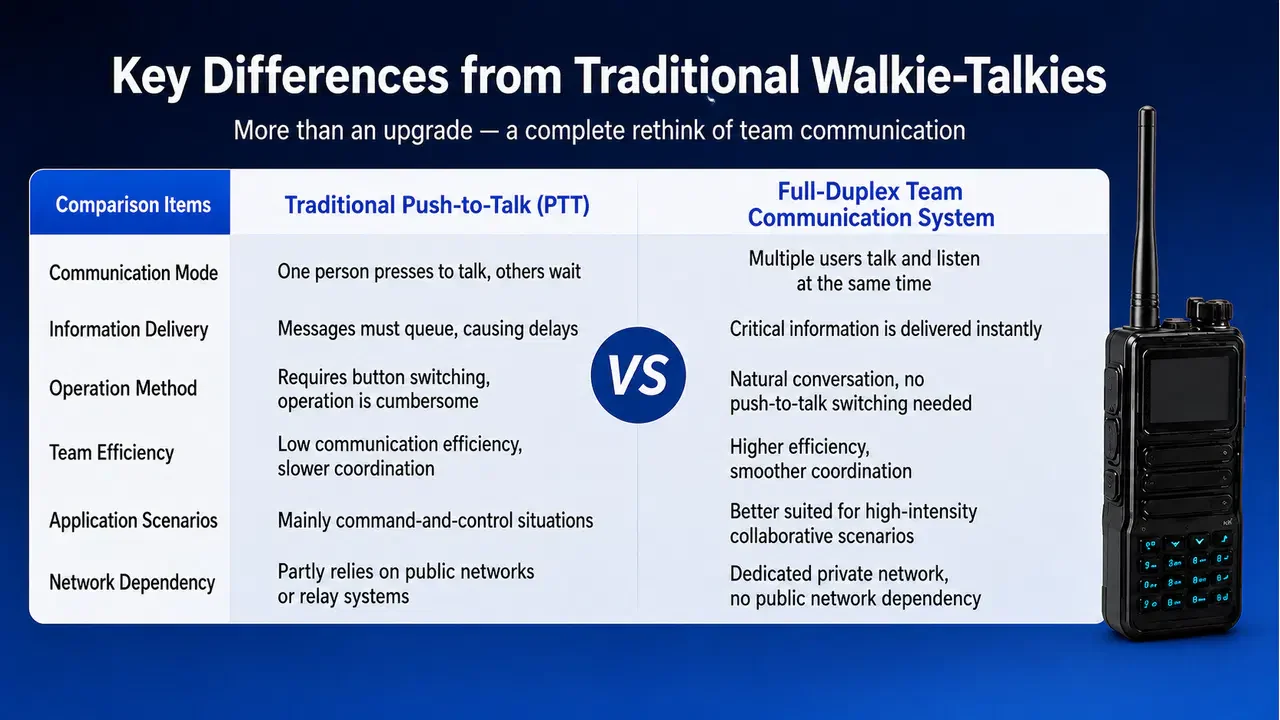
The comparison below is the one our application engineers use when a team is deciding whether full-duplex is worth the change. It is not a claim that push-to-talk is obsolete; it shows where each mode stops fitting.
- Push-to-talk: one person presses to talk, others wait; messages queue and operation requires button switching.
- Full-duplex: multiple users talk and listen at the same time, without push-to-talk switching.
- Push-to-talk relies partly on public networks or relay systems; the full-duplex system uses a dedicated private network.
System capacity: 32 terminals, 4 groups, 8 users
The capacity of the system is defined at the gateway, not at the handset. One cluster gateway supports connection for up to 32 handheld terminals, which is enough for a property team, a rescue unit, a venue crew or a plant inspection group working across several zones of the same site.
Communication is organized into as many as four independent groups, without interference between groups. A patrol group, a control room group, a technical group and a support group can operate at the same time on the same gateway while their traffic stays separate. Each group supports simultaneous two-way voice for up to eight full-duplex users, so a group of eight can hold a natural conversation rather than a sequence of announcements.
The radio layer is a private Sub-1G network. The system is built locally and does not depend on public-network coverage, which is the practical reason it is specified for basements, tunnels, metal corridors, remote drill sites and crowded venues where cellular service is weak, congested or absent.
- Up to 32 handheld terminals on a single gateway.
- Four independent groups with no interference between groups.
- Up to eight full-duplex users per group.
- Private Sub-1G network, locally deployed without public-network coverage.
System components and operating method
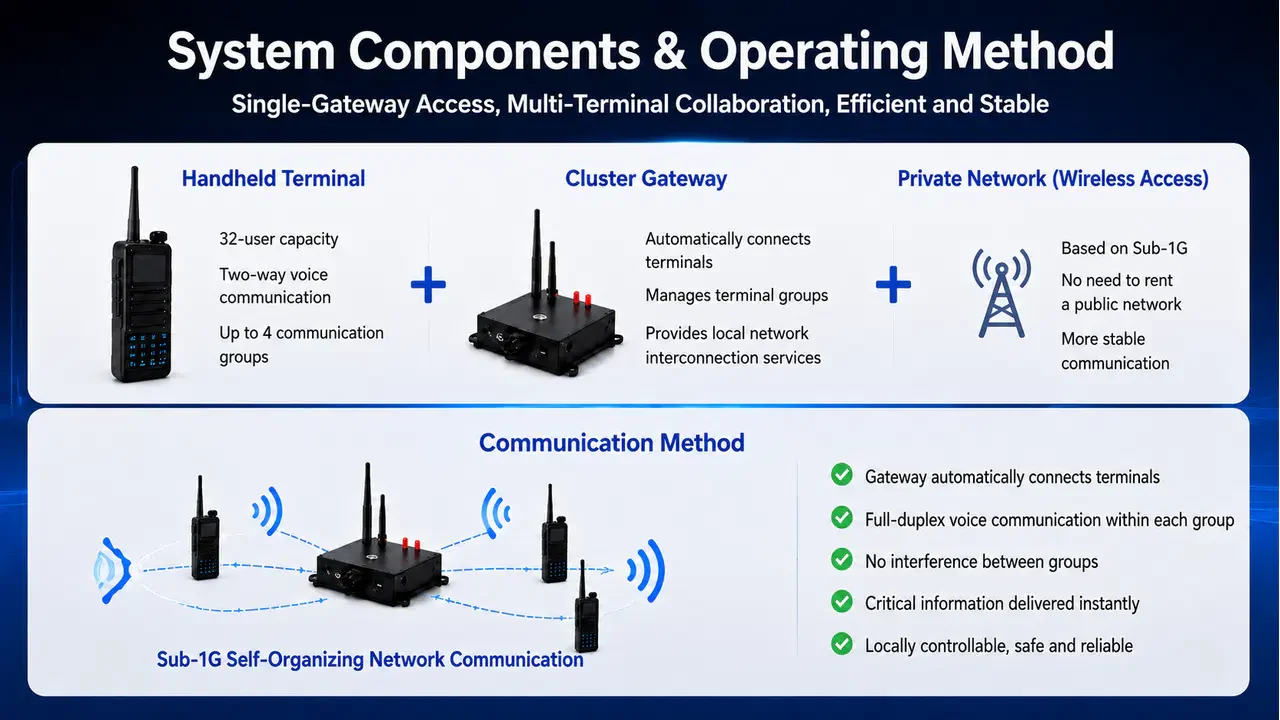
Handheld terminals connect automatically to a cluster gateway that manages terminal groups and provides local network interconnection through Sub-1G wireless access. The locally controlled architecture supports independent group communication without renting or depending on a public network.
In operation, the terminal is carried by the person moving through the site; the gateway stays at a fixed point such as a control room, an engineering office or a backstage technical room. Because the gateway is the control point, group assignment is a property of the site rather than of the handset, which keeps the structure stable when staff rotate between shifts.
The diagram below summarizes the three parts of the system: the handheld terminal with two-way voice and up to four communication groups, the cluster gateway that connects terminals and manages groups, and the private Sub-1G wireless access that removes the need to rent a public network.
Professional audio and connectivity
The system combines low-latency full-duplex voice, microphone and speaker support, noise reduction, echo cancellation and Bluetooth headset compatibility. Sub-1G wireless access and dedicated audio processing support clear and stable communication across complex working environments.
Two audio details decide whether a team keeps using the system after the first week. The first is the return path: without echo cancellation, a terminal that hears its own speaker output makes people stop talking, and the conversation collapses back into turn-taking. The second is the noise floor: in a venue, a plant or beside a vehicle, steady background noise masks the consonants that carry meaning, so noise reduction is applied before the signal leaves the terminal.
Microphone and speaker interfaces on the gateway allow a fixed audio position — a control desk or a command post — to join the network without holding a handset. Bluetooth headset support keeps both hands free for the work itself: operating equipment, handling a map or changing a prop during a take.
- Real-time full-duplex voice: multiple people talk and listen simultaneously, with no push-to-talk switching.
- End-to-end low latency for immediate response.
- MIC / speaker support on the gateway, ready to use.
- Noise reduction and echo cancellation for complex acoustic environments.
- Bluetooth headset support for flexible collaboration.
- Dedicated audio processing for loud and clear sound.
A different team communication experience
Unlike traditional push-to-talk systems, full-duplex users can speak and listen simultaneously without button switching or queued messages. Immediate information delivery and smoother coordination make the system suitable for high-intensity collaborative work that requires locally controlled communication.
The practical change is easiest to see in the length of an exchange. A guard reporting an incident, a control room asking for the level, and a third person confirming the access route can happen inside one conversation instead of three separate transmissions. The same pattern applies to direction and sound on a film set, stage and floor crews in a venue, and command and search groups on a drill site.
Locally controlled communication also changes ownership. The team that runs the site runs the network: there is no subscription to renew, no third-party platform between the speaker and the listener, and no external service that has to be available for an internal conversation to take place.
Technical specifications overview
The handheld terminal supports full-duplex two-way voice, Sub-1G operation, up to four groups, Bluetooth and Type-C charging, with audio enhancement and a replaceable lithium battery. The gateway supports up to 32 terminals, four independent groups, microphone and speaker ports, Ethernet and Type-C connectivity, PUF-based encryption and DC 9–36 V power.
The tables below are the specification set used by our application engineers during configuration planning. They describe published values only; coverage distance and battery runtime depend on the site and the shift pattern, so they are not stated here as fixed numbers.
Table 1
Handheld Terminal
Operator-carried unit for full-duplex voice within a group, designed for continuous use on site.
| Communication Mode | Full-duplex simultaneous two-way voice |
|---|---|
| Network Access | Sub-1G private network to Cluster Gateway |
| Operating Groups | Up to 4 selectable groups |
| Audio Processing | Noise reduction and echo cancellation |
| Headset Support | Bluetooth headset compatible |
| Charging Interface | Type-C |
| Battery | Replaceable lithium battery |
| Mounting | Belt clip for hands-free carrying |
Table 2
Cluster Gateway
Locally deployed control unit that connects terminals, manages groups and interfaces with your network.
| Terminal Capacity | Up to 32 terminals |
|---|---|
| Independent Groups | 4 |
| Full-Duplex Users | 8 per group |
| Audio Interfaces | Microphone input and speaker output |
| Network Interface | Ethernet and Type-C |
| Security | PUF hardware-level authentication and encryption |
| Power Supply | DC 9-36V wide voltage input |
| Deployment | Local installation, no public network required |
Specification values are reproduced from the published KingNeed product solution document and the system datasheet. Request the datasheet for the full parameter list.
Built for professional team communication
The platform combines full-duplex communication, group management, stable wireless performance and advanced security in one locally deployable system. Flexible adaptation and service support help professional teams establish efficient, safer and more reliable communication for demanding applications.
Project support covers the work around the hardware: terminal count and group structure planning, gateway placement, integration with an existing control room or site network, and delivery arrangements for the procurement process. Those four items are usually what determines whether a deployment is used as designed or slowly reverts to a single shared channel.
Getting pricing and technical details
Talk with a KingNeed specialist about the right configuration, integration and delivery requirements for your project. A useful first message includes the site layout, the number of people per shift, the functions that need separate groups, and whether a control room or dispatch position needs a fixed audio point.
Document note: at the time the source product document was prepared, no product-specific solution article had been linked to it. The published solution articles now live in the resource centre and cover private-network planning, group structure, device security, venue audio and battery practice.
- Site layout, levels and working zones.
- Team size per shift and the functions that need separate groups.
- Existing control room, dispatch desk or site network.
- Required delivery date and procurement process.
Frequently asked questions
- Does the system require a public network or cellular coverage?
- No. Terminals connect to the cluster gateway over a Sub-1G private network, and the gateway is deployed locally at the site. The system operates without a rented communication platform and without depending on cellular coverage.
- How many terminals can one gateway support?
- A single cluster gateway supports up to 32 handheld terminals, organized into four independent groups with up to eight full-duplex users per group.
- Do the groups interfere with each other?
- No. The gateway keeps the four groups independent, so a conversation in one group is not heard in another. Command, operations, technical and support traffic can run at the same time.
- What is the difference between full-duplex and push-to-talk operation?
- Push-to-talk allows one person to speak while others wait, and each transmission requires a key press. Full-duplex allows team members to speak and listen at the same time, so information is passed during a natural conversation.
- Can the terminals be used with headsets?
- Yes. The handheld terminal supports Bluetooth headsets, which keeps both hands free while the operator stays connected to the group.
- How are the terminals and the gateway powered?
- The handheld terminal uses a replaceable lithium battery and charges over Type-C. A single gateway accepts a DC 9-36V wide voltage supply.
- How is communication security handled?
- The gateway uses PUF hardware-level authentication and encryption, so device identity is anchored in hardware and the network stays closed to authorized terminals.
- What support is provided for configuration and integration?
- Configuration planning covers terminal count, group structure and gateway placement. Integration support covers the Ethernet connection to a control room or dispatch position and the audio interfaces for a fixed station. Delivery coordination is handled with the procurement team.
How this guide was prepared
- 01
This guide was prepared by the KingNeed Application Team from the published seven-page product solution document for the full-duplex team wireless communication system, and cross-checked against the specification table used for deployment planning.
- 02
Promotional phrasing in the source document was rewritten as an operational statement. Where the original used an absolute claim, this article states what the system does and under which condition it applies, so a technical reader can verify it against the datasheet.
- 03
Diagrams and photographs are reproduced from the source document and are not simulated renders of a different product.
Scope and limitations
- This article does not include a site survey, measured coverage distance or measured battery runtime. Those figures depend on wall construction, metal density, terminal placement and shift length.
- Capacity figures describe the gateway limit. The usable configuration for a specific site also depends on how groups are structured and where the gateway can be installed.
- Regulatory approval and frequency allocation vary by country; confirm the Sub-1G band requirements for the destination market before ordering.
References
About the author
The KingNeed Application Team plans terminal counts, group structures and gateway placement for security, emergency response, event, film and industrial projects. KingNeed has designed and manufactured electronics in Zhongshan, China since 1995, working across smart hardware and IoT terminals.
- 30+ years of electronics manufacturing since 1995
- In-house radio, audio and structural engineering
- Deployment planning for security, events and industrial teams